
For Dorothea Dejonckheere, painting emerges in silence.
Layer after layer, color settles, withdraws, and reveals unexpected forms. The gesture is slow, almost meditative. Painting becomes a space for breathing, a way of suspending the rhythm of the world.
Abstraction entered her life very early, almost as an obvious path nourished by childhood: drawing, collecting, observing, and later profoundly shaped by the work of Mark Rothko. In his fields of color, she discovered the possibility of conveying pure emotion without the need for words. This revelation has never left her.
Her journey, however, has not been linear. After her studies, a loss of direction and a burnout marked a pause. It was at this turning point that painting reappeared, first as an intimate, almost fragile experience. Gradually, it became a rediscovered language. Structures, the repetition of the line, and the layering of materials rebuild a calm inner space.
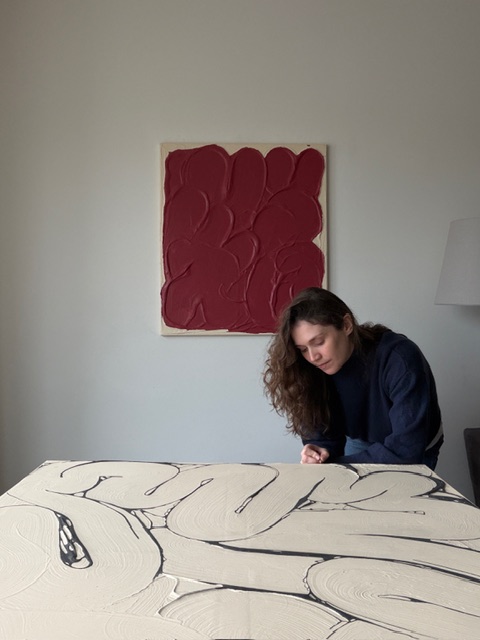
Today, her works unfold like evocative landscapes. The eye wanders through patterns, lines, and areas of density and light. Each canvas is conceived as a mirror: a place where the viewer can slow down, breathe, and reconnect with what lies within.
In a society marked by constant acceleration, Dorothea offers a pause. An invitation to fully inhabit the present moment.
Her process is intuitive and organic. Painting develops over time, through the almost ritual repetition of gestures, often combined with pencil work. This slowness is not merely an aesthetic choice; it is a necessity. It allows her to organize her thoughts, move through emotions, and find a form of clarity.
Although her work remains deeply abstract, it is nonetheless permeated by life. “Het Portret,” created during her pregnancy and conceived for her son, is its most intimate expression. A work filled with a silent presence, where matter becomes memory.
More than images, Dorothea Dejonckheere creates spaces to be felt.
Works that do not seek to explain, but to evoke experience: the gentleness of slowing down, the beauty of small things, the necessity of pausing.
In a world saturated with images and continuous production, her practice defends another temporality: one of attention, authenticity, and profoundly human creation.