
Biography & Artistic Approach
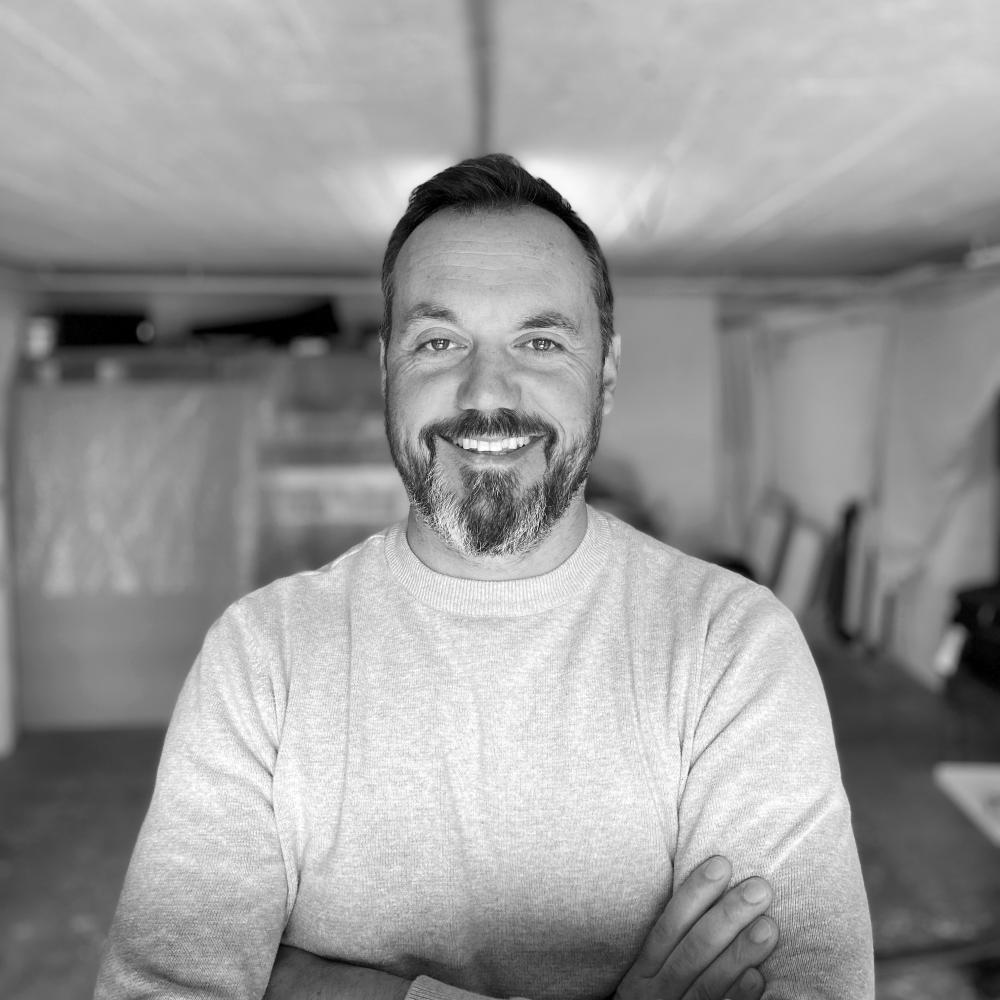
Born in Brussels on August 24, 1976, BrieucC grew up in a lineage where art was not a choice but an evident calling. From an early age, he developed a practice of drawing and painting, guided by a keen sensitivity to balance, the internal tensions of forms, volumes, and colors. This almost instinctive sensibility forms the foundation of his artistic language.
However, it is light — constant and obsessive — that acts as the true trigger. Long anticipated, it became in 2014 a medium in its own right with “La Porte”, his first work incorporating artificial light. This foundational and highly symbolic piece marked a decisive rupture and inaugurated a new direction in his research.
From then on, BrieucC’s work has focused on perception and movement, considered as inseparable phenomena. Rejecting any dispersion, he developed a radical and immediately recognizable approach, which he calls “angular art.” Within a deliberate economy of means, he composes exclusively from straight lines, cut into wood with an almost architectural precision. This formal rigor, however, generates an unexpected dynamism: movement is not contained within the object but activated by the viewer’s gaze.
Here, the work is never experienced from a single point of view. It unfolds through the movement of the spectator. As they move, planes open, contrasts emerge, light circulates, and the space is recomposed. The physical experience thus becomes inseparable from the understanding of the work: to see is to act.
Although clearly rooted in a kinetic tradition, BrieucC distinguishes himself through a demanding approach to perception. Movement is neither simulated nor decorative; it constitutes the very condition of the work’s appearance. The pieces, which he describes as “living,” exist fully only within this interaction. They establish a direct, almost silent relationship, where the spectator becomes an integral part of the process.
Beyond their apparent simplicity, these works question the relativity of vision. Nothing is ever perceived except from a given, partial, and unstable position. By inviting multiple points of view and encouraging the movement of the body to expand perception, BrieucC offers an experience that goes beyond mere aesthetics.
"Only movement and our ability to open ourselves to other fields of vision allow us a fuller understanding of reality."
This philosophy permeates a body of work of remarkable coherence, whose formal and conceptual singularity now establishes an immediately recognizable signature.
